ATL Automatic Truck Loading


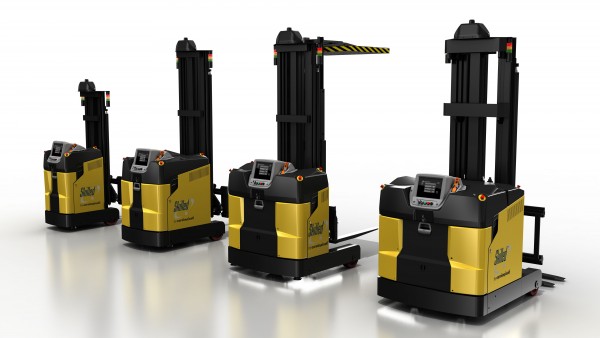
Just a few years ago, automated internal transport was mainly associated with warehouses and simple pallet movements between production lines and storage areas. Today, the technology has evolved much further. More and more manufacturing companies are investing in autonomous LGV/AGV vehicles and ATL systems (Automatic Truck Loading), capable of loading trucks completely autonomously – without a forklift operator.
What once seemed futuristic is now becoming a real direction for modern factories and advanced logistics centers.
What is ATL?
ATL stands for Automatic Truck Loading. It refers to the automation of loading trucks and trailers using autonomous guided vehicle systems.
The solution developed by Skilled Group was created based on extensive experience in end-of-line automation and the growing demand for automation in dispatch and internal logistics areas.
The system uses autonomous LGV vehicles equipped with advanced navigation, bi-dimensional scanners, and vision-guidance technology, allowing the vehicle to:
- move without an operator,
- recognize loading areas,
- autonomously pick up pallets,
- independently enter trailers,
- place pallets according to the loading pattern.
The entire process takes place without human intervention.
How Do Autonomous LGV Vehicles Work?
LGV (Laser Guided Vehicle) systems are advanced autonomous transport vehicles that operate without drivers. Unlike traditional AGV systems, they do not require floor guides or magnetic tracks. Using lasers, scanners, and safety systems, they continuously analyze their surroundings and determine the optimal route.
The main advantages of these systems include:
- 24/7 operation,
- repeatability and safety,
- reduction of operator-related errors,
- lower logistics costs,
- integration with production lines and ERP/MES systems,
- elimination of downtime in dispatch areas.
In practice, this means that finished pallets can automatically leave the production line, move through the warehouse, and finally be loaded onto trucks — all without a forklift operator.
An Ideal Solution for Logistics Centers
ATL systems are not only perfect for manufacturing plants, but also for modern logistics centers and high-bay warehouses.
In logistics operations, the key priorities are:
- shipment speed,
- minimizing errors,
- maximum loading dock efficiency,
- continuous operation,
- employee safety,
- automation in response to labor shortages.
Autonomous LGV vehicles and ATL systems automate one of the most demanding logistics operations — truck loading. As a result, logistics centers can significantly increase operational efficiency, reduce truck loading times, and lower internal transport costs.
This is especially valuable for large logistics facilities handling hundreds of pallets and dozens of trucks every day.
Why Is ATL Attracting So Much Attention?
In many facilities, the biggest challenge today is no longer production itself, but end-of-line logistics. Labor shortages, increasing operational costs, and the need for higher efficiency are driving companies to search for smarter automation solutions.
ATL addresses these challenges directly.
Automatic truck loading allows companies to:
- reduce truck loading times,
- improve workplace safety,
- minimize pallet and product damage,
- reduce forklift traffic in loading areas,
- improve warehouse organization,
- maintain continuous operations.
Additionally, the entire process can be monitored and analyzed in real time.
Industries Using ATL Systems
ATL systems and autonomous LGV vehicles are used across a wide range of industries, including:
- food & beverage,
- paper and tissue,
- pharmaceutical,
- cosmetic,
- chemical,
- automotive,
- electrical,
- glass,
- tobacco,
- dairy,
- logistics and warehousing.
The greatest benefits are achieved in facilities with high shipping volumes and repetitive logistics processes.
Automatic Truck Loading – A Technology You Need to See in Action
ATL is one of those technologies that cannot be fully understood from pictures alone. Seeing an autonomous vehicle independently entering a trailer and positioning pallets without any operator truly demonstrates the possibilities of modern automation.
Only a few years ago, this type of technology was limited to the world’s most advanced factories. Today, more and more companies are considering implementing it in their own operations.
End-of-line and logistics automation is no longer the future. It is becoming the standard for modern manufacturing and logistics centers.